Shopify Native or AI Personalization Platform: What Retailers Need to Know
For retailers, the storefront is a revenue channel. Every improvement in conversion rate, every increase in average order value, every reduction in bounce rate compounds at scale.
The question isn’t whether personalization matters. The data is unambiguous. The question is whether your current setup is built to deliver it.
Shopify is the platform of choice for many of the world’s fastest-growing retail brands. But as organizations scale, the gap between what Shopify’s native tools offer and what enterprise commerce demands becomes a strategic consideration, not just a technical one.
What Shopify native gives you
Shopify’s built-in tools are designed for speed and simplicity. Standard recommendation blocks, basic merchandising rules, and theme-based layouts let teams move quickly without significant development overhead.
For lean teams managing straightforward catalogs, that works. But for some retailers, they face a different set of challenges: large and complex product catalogs, diverse customer segments, high-traffic peak periods, and internal teams with competing priorities and limited bandwidth to manage manual rules at scale.
At that level, static experiences don’t just underperform. They represent a measurable revenue gap.
The cost of a one-size-fits-all storefront
When every shopper sees the same search results, the same category ranking, and the same recommendations regardless of intent or behavior, you’re leaving conversion on the table at every touchpoint.
In practice, that looks like this:
- A high-value returning customer sees the same homepage as a first-time visitor
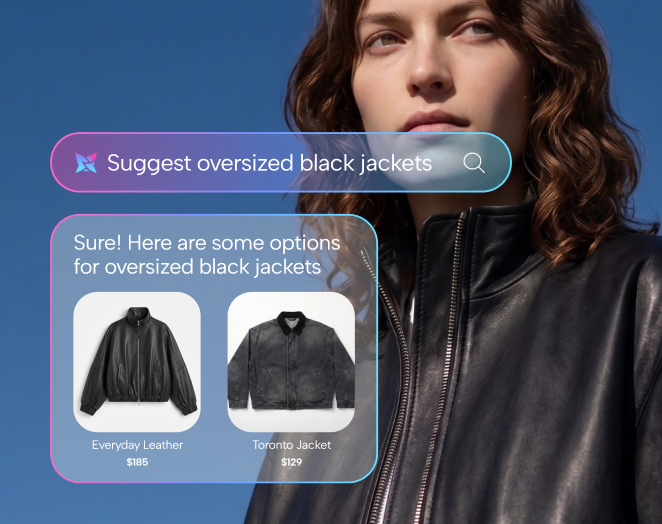
- A shopper who just bought outerwear gets the same “jacket” search results as someone browsing for the first time
- Category pages apply identical sort orders during a flash sale as they do mid-season
- Recommendations ignore what’s in the basket, what’s been browsed, or what’s running low in stock
For retailers with large catalogs and diverse customer bases, these aren’t edge cases. They’re the default state of a non-personalized storefront, and the cumulative revenue impact is significant.
What an AI personalization platform adds
Personalization platforms are built to work within Shopify’s architecture. Nosto integrates natively with existing Shopify themes, so your development team isn’t rebuilding storefront components and your merchandising team isn’t managing two separate environments.
The intelligence layer operates beneath the surface. What changes is what each shopper experiences, and how that experience adapts in real time.
For your merchandising team: Boost and suppress products based on inventory levels, return rates, conversion data, margin, and revenue per visitor, across search, category pages, and recommendations simultaneously. One rule set, applied consistently, without manual updates across multiple systems.
For your marketing team: Segment-level personalization means different customer groups see different product rankings, content blocks, and promotional messaging, triggered by behavioral signals, lifecycle stage, or email platform data. Klaviyo integration included.
For your ecommerce leadership: A single intelligence layer governing Product Discovery across the entire storefront, with performance data feeding directly back into merchandising decisions. Measurable impact on conversion rate, AOV, and revenue per visitor.
Agentic Commerce: Where the Competitive Gap Widens
Research shows 72% of shoppers in the UK and US now expect AI-powered assistance during the shopping journey. Retailers that meet this expectation at scale will widen the gap on those that don’t.
Nosto’s AI agent, Huginn, moves beyond static personalization to continuously interpret behavioral, transactional, and contextual signals and act on them. Across search, content, recommendations, and merchandising, Huginn orchestrates the full Product Discovery experience in real time, without requiring manual input from your team.
This is Agentic Commerce: intelligence that adapts the customer journey as purchase intent becomes clearer. For retailers managing complex catalogs and high-value customer relationships, it’s the capability that separates high-performing storefronts from the rest.
Is It Worth Building In-House?
Sometimes retailers evaluate whether to build personalization capabilities internally. It’s worth being direct about what that involves: significant engineering resource, ongoing model training and maintenance, and a roadmap that competes directly with your core commerce priorities.
One factor that often shapes this decision is the full cost of running on Shopify Plus. The plan fee is just the starting point. Payment processing, app subscriptions, agency retainers, and development projects all contribute to the real number. If you’re evaluating where to invest next, understanding your baseline spend matters. Shero Commerce has put together a detailed Shopify Plus pricing breakdown that covers plan tiers, payment fees, and the variables most brands underestimate.
Which Approach Is Right for Your Business?
Shopify native is appropriate if:
- Catalog complexity is low, and customer segments are broad
- Personalization is not yet a strategic priority
- Operational simplicity takes precedence over conversion optimization
An AI personalization platform is the right investment if:
- You’re scaling a large or complex catalog, and Product Discovery is a growth constraint
- Your merchandising, marketing, and ecommerce teams need a unified intelligence layer
- You’re experiencing conversion and AOV pressure that static experiences can’t address
- You’re building toward Agentic Commerce and need a platform that scales with that ambition
Conclusion
For retailers, the difference between Shopify’s native capabilities and a purpose-built AI personalization platform isn’t a feature comparison. It’s a revenue conversation.
Personalization platforms extend Shopify with the merchandising depth, behavioral intelligence, and agentic capabilities that enterprise or high-end commerce demands. The result is a storefront that doesn’t just present products. It actively guides high-value shoppers toward conversion, at scale, without adding operational overhead.