Personalized Search
 Category Merchandising
 Product Recommendations
 Post-Purchase Upsell
 Dynamic Bundles
 Personalized Emails
 A/B Testing & Optimization
 Content Personalization
 Behavioral Pop-Ups
 Shoppable UGC
 Shopify Plus
 Shopify
 Salesforce Commerce Cloud
 Shopware
 Adobe Commerce
 BigCommerce
 Klaviyo
 Attentive
 Yotpo
Yotpo Tapcart
 Google Analytics
 TikTok
 Instagram
 Facebook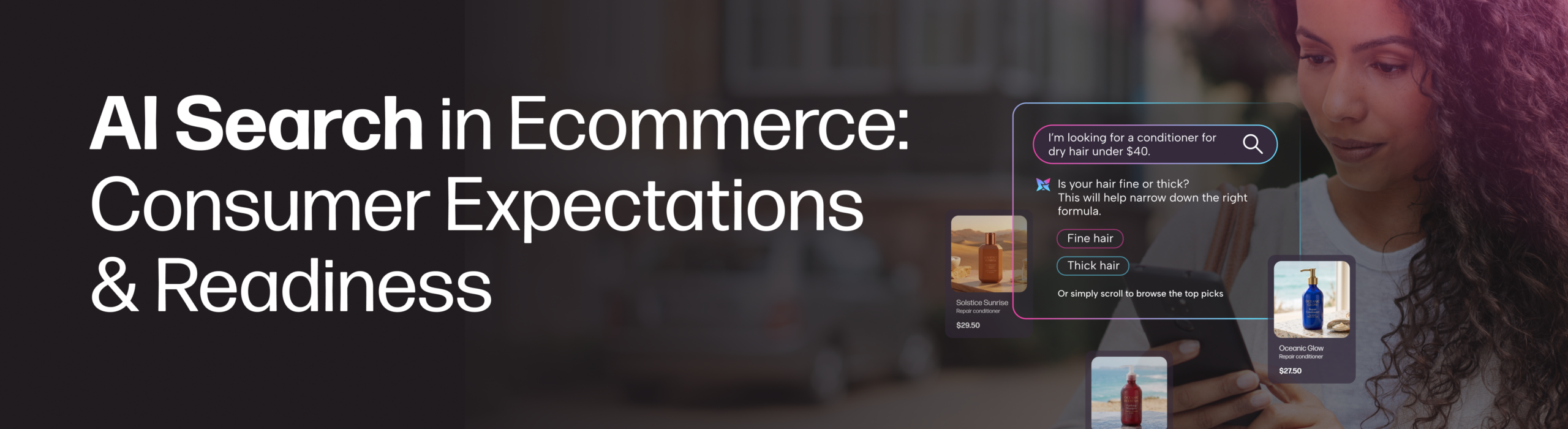
New research: Retailers without onsite AI search risk losing shoppers to ChatGPT and Claude
40% of online shoppers are likely to turn to AI assistants if retailers’ onsite search doesn’t deliver – while 72% have already tried or are open to retailers using AI to improve their onsite search
New York, September 18 – 59%¹ of US and UK consumers surveyed admit they often leave ecommerce stores because the onsite search is poor. But in addition to leaving to search on Google or a rival online retailer, 40% now say they’re likely to switch to the likes of ChatGPT or Claude when they’re shown irrelevant onsite search results.
The same number (40%²) also agree that AI agents such as ChatGPT and Claude are now more helpful than the onsite search tools offered on many online shopping sites.
The survey of 2,000 US and UK consumers suggests that while shoppers are prepared to try to overcome poor onsite search by rewriting queries or using filters to narrow down the results, a substantial proportion are likely to leave when they see irrelevant results: 62% are likely to go to Google; 53% are likely to go to another shopping website; and 40% are likely to turn to a general AI tool like ChatGPT or Claude (rising to 50% for consumers under 45)³.
The research, which was commissioned by Nosto, the agentic Commerce Experience Platform (CXP) platform, indicates that shoppers are often dissatisfied with the quality of results and the practical difficulties of using onsite search on ecommerce sites.
Tuukka Häkkinen, Chief Product Officer at Nosto, said: “Consumers’ expectations about ecommerce onsite search are likely to have been raised by their experience of using AI assistants. This may explain why four in ten now say they are likely to leave ecommerce stores for the likes of ChatGPT or Claude when they’re not happy with the onsite search results. It’s a wake-up call for retailers to improve their search or risk driving shoppers away.”
The frustrations shoppers say they come up against ‘often’ aren’t just about irrelevant results. The data suggests that traditional onsite search forces them to do too much work. As well as the results not matching what they typed (64%), shoppers complain about being shown too many results to scroll through (search overload) (70%); the struggle of finding the right words to describe what they want (62%); and the same products being listed even after changing the search terms over and over (66%)¹.

Many of these frustrations are because traditional onsite search is not able to understand shopper intent, a problem which AI is better at handling, according to Tuukka Häkkinen:
“Shoppers often struggle to find the precise words to describe what they’re searching for–at times, they might have only a vague idea. In fashion, for example, someone might be looking for ‘a smart casual outfit for a summer wedding’, rather than searching for a very specific product.
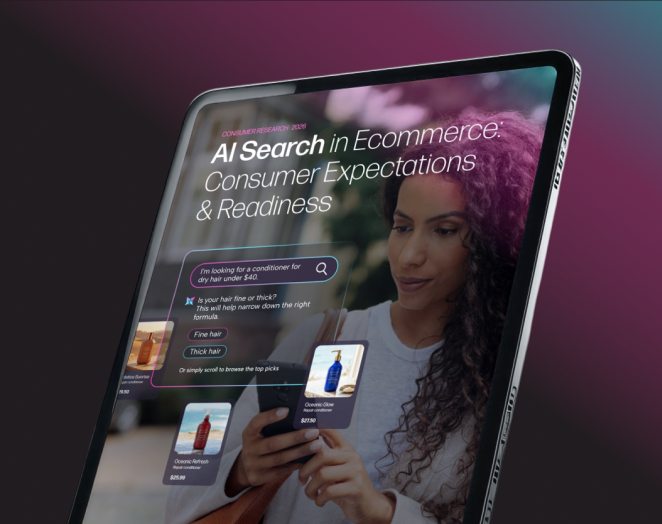
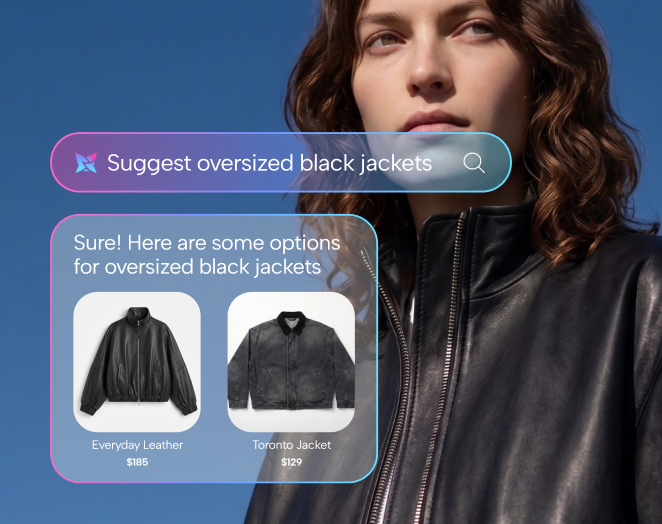
“AI is better able to address this type of query because it goes beyond simple keyword matching – by understanding more natural conversational language and descriptions. And by asking follow-up questions, AI can help narrow down options. It’s got the potential to make product discovery easier, quicker and less frustrating.”
Shoppers are ready for retailers to bring AI into onsite search
The good news for online retailers is that most shoppers are receptive to AI being used directly on retail sites to enhance onsite search; 72% have already tried or would be open to retailers using AI to improve search on their sites. 63%⁴ agree it would help if an AI assistant helped them refine or improve their search query on a retail site by asking additional questions to clarify what they are looking for.
Among consumers who have already used AI-powered onsite search on retail shopping sites, more than 95% believe AI search technology can be helpful in a variety of ecommerce sectors or types of purchase. The ecommerce sectors where they see AI being most helpful are Electronics and Appliances (33%) and Clothing and Fashion (32%), followed by Groceries and Everyday Essentials (29%), and Beauty and Skincare (25%).
When Nosto’s survey asked consumers what they would want or expect if retailers introduced AI to improve onsite search, many answers matched the frustrations they highlighted about traditional ecommerce search.
As well as wanting AI to help them find products faster (34%), they want it to narrow down choices (30%), to understand what they mean even when their search queries are not clear (27%); show fewer, more relevant products instead of long lists of less relevant results (26%); and to guide them by suggesting products when they’re unsure about what they want (24%).

Consumers’ main concerns about using AI to improve onsite search relate to privacy, control, and transparency. 73% are concerned that stores will track and collect their personal data to train AI; 71% that AI will recommend products to increase retailer profits rather than focusing on what’s best for shoppers; and 69% that shoppers will be forced to use AI without being able to switch back to traditional search. 69% are also concerned that AI features will interrupt and distract them while they shop⁵.

According to Häkkinen, retailers will need to earn shoppers’ trust by being clear about when their data is being used to improve AI-powered search, what data is involved and why. They should also be given the ability to turn the AI experience on or off. The ideal product discovery experience should use AI in several ways he said:
“First, AI can work in the background to make search better by understanding less precise queries and returning more relevant results. On top of that, agentic capabilities can proactively help shoppers refine those results, for example by asking follow-up questions, or automatically applying relevant filters, all without getting in the shopper’s way and with the option to undo or turn off these actions. And when shoppers want more help, they should be able to trigger a chat with an AI shopping agent for a more guided conversational experience.”
“Personalization technology can be used to ensure that AI-powered search results are even more relevant to individual shoppers. By prioritizing products that best meet shoppers’ needs, personalization also helps deliver the best results for the retailers’ business.”
Download the full survey report from Nosto here.
Notes
¹Combines ‘very often’ and ‘somewhat often’
²Combines ‘somewhat agree’ and ‘strongly agree’
³These numbers combine ‘very likely’ and ‘somewhat likely’
⁴Combines’very helpful’ with ‘somewhat helpful’
⁵Combines ‘very concerned’ and ‘somewhat concerned’
About the consumer survey
Nosto commissioned international market research consultancy Censuswide to conduct a survey of a nationally representative sample of 2,000 UK (1,000) and US (1,000) consumers between 09.07.2026-13.07.2026. Censuswide is a member of the Market Research Society and the British Polling Council, and a signatory of the Global Data Quality Pledge.
About Nosto
Nosto is the agentic Commerce Experience Platform (CXP) that helps brands increase online revenue through AI-powered search, personalization, merchandising, and purpose-built agents.
With experience.AI™, Nosto’s intelligence engine, brands can enrich and connect customer, product, and content data in real-time and make it actionable to deliver more relevant commerce experiences at every step of the customer journey.
With Huginn, the AI commerce agent orchestrating a network of purpose-built agents, brands unlock new levels of productivity and relevancy, accelerating the path from ideation to execution and enhancing every customer interaction.
Nosto supports intelligent commerce experiences for more than 1,500 brands in over 100 countries, including Kylie Cosmetics, O’Neill, New Era, Marc Jacobs, Belstaff, FIGS, and Todd Snyder, Showroomprivé, Douglas, Muji, Diane Von Furstenberg, and Tuckernuck.