Commerce Search
 Category Merchandising
 Product Recommendations
 Post-Purchase Upsell
 Dynamic Bundles
 Personalized Emails
 A/B Testing & Optimization
 Content Personalization
 Behavioral Pop-Ups
 Shoppable UGC
 Shopify Plus
 Shopify
 Salesforce Commerce Cloud
 Shopware
 Adobe Commerce
 BigCommerce
 Klaviyo
 Attentive
 Yotpo
 Tapcart
 Google Analytics
 TikTok
 Instagram
 Facebook

Usually, yes. Relevance tuning, catalog syncing, and UI updates all need regular developer involvement. If your dev team is small or shared, those tasks will create delays for your ecommerce team.
Algolia reviews: what ecommerce teams actually think
Algolia is a search Application Programming Interface (API) built for speed. A lot of ecommerce teams end up evaluating it because it’s fast, well-documented, and widely used across industries.
If you’re deciding whether Algolia fits your store, this breakdown on Algolia reviews covers what ecommerce teams actually report: what works, what it costs at scale, and where the platform runs into limits.
What do ecommerce teams say about Algolia?
Across hundreds of verified reviews on G2, Gartner, and the Shopify App Store (as of November 2026), a few patterns come up again and again:
- Search speed and accuracy are consistently praised across every platform.
- Reviews tend to be particularly positive from technical teams, while ecommerce operators less so.
- Costs can surprise you fast. Overages, add-ons, and developer hours stack up quickly.
- The support you get depends heavily on the plan you are paying for.
- If you need search, merchandising, and personalization to work together, be prepared for significant integration work.
Who should use Algolia?
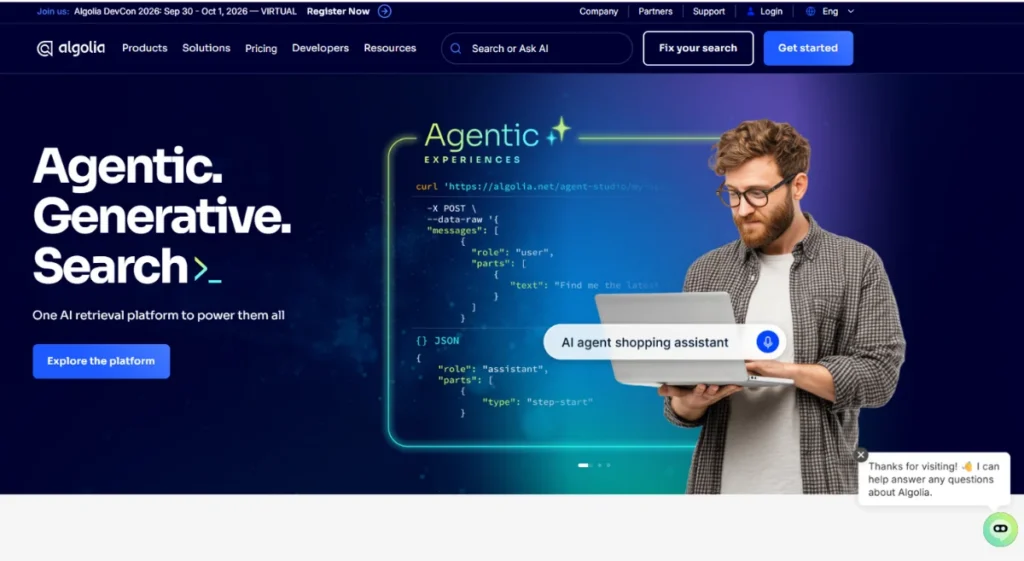
Algolia is a search engine you plug into your website or app. It processes search queries, finds the most relevant results from your product catalog, and returns them fast.
You get a lot of control over how results are ranked, filtered, and displayed. But exercising that control requires your developers to configure and maintain it.
Because of its API-first architecture, Algolia is often a strong fit for organizations with dedicated engineering resources.
It serves more than 18,000 businesses across industries like media, SaaS, and retail, and it does the core search job very well.
You will likely get the most out of Algolia if you:
- Have a dedicated development team to build and maintain a custom search experience.
- Sell across multiple countries and need multi-language support out of the box.
- Want low-level control over how search results are ranked and displayed.
It may be less suitable if you:
- Have a small or shared dev team, and search is just one of many things on their plate.
- Need search, category pages, and recommendations to work from the same shopper data, without manually stitching tools together.
- Want your merchandising team to adjust search without going through a developer every time.
What Algolia does well
Before getting into the limitations, here is where Algolia genuinely earns its reputation.
Speed and search relevance at scale
The thing reviewers mention most, across G2, Capterra, and the Shopify App Store, is how fast and accurate Algolia’s search is, even for large catalogs and high-traffic environments.
And if they misspell something? Algolia catches it without you having to configure anything.
Synonym handling works the same way, straight out of the box. So if a shopper searches “couch,” but your catalog says “sofa,” Algolia connects them automatically.
On G2, search speed and search effeciency are among the most commonly praised aspects of the platform. (as of November 2026)
One AWS Marketplace reviewer with a large production catalog noted that traffic spikes of 5 to 10 times their normal volume did not require any changes on their end.
Developer flexibility and API customization
As we said earlier, your engineering team gets a lot of control with Algolia. SDKs (Software Development Kit) cover JavaScript, Python, PHP, Ruby, Go, and more.
And pre-built front-end search components (called InstantSearch libraries) in 6 popular frameworks mean your developers do not have to build the search User Interface (UI) from scratch.
Algolia AI search optimization reviews from developers are largely positive.
NeuralSearch, for example, combines traditional keyword matching with vector search in a single API call, so the search understands what a shopper means rather than matching only their exact words.
That makes results more useful for vague or unusual queries.
That level of control does come with a tradeoff, though. Every time you want to change how results are ranked, update the search UI, or tune relevance for a new product category, a developer needs to be involved.
A/B testing for site search and category merchandising in a more integrated platform can be handled by your ecommerce team directly. With Algolia, that handoff to engineering is typically required.

What does Algolia actually cost?
Algolia pricing comes up in nearly every review thread, and for good reason. The total cost is harder to predict than the published tiers suggest.
| Plan | Records included | Queries/month | Notes |
| Free | 10,000 | 10,000 | Suitable for prototyping only; not viable for live ecommerce catalogs |
| Grow | Up to 100K | Up to 1M | Usage-based; costs increase with catalog and traffic scale |
| Grow Plus | Custom | Custom | Enterprise pricing, not publicly listed |
| Elevate | Custom | Custom | Full AI and advanced features; enterprise negotiation required |
On Grow, additional records cost $0.40 per 1,000, and additional queries cost $0.50 per 1,000.
The Grow Plus tier, launched in late 2025, adds AI Ranking and Advanced Personalization for $1.75 per 1,000 queries.
Enterprise pricing is negotiated directly with Algolia and is not publicly disclosed. Total cost will depend on factors such as traffic volume, record counts, feature requirements, and support levels. However, procurement data from Vendr puts the average annual enterprise spend at around $150,000–$500,000+.
Beyond licensing, there are 3 costs that tend to catch teams off guard:
- Add-ons: Features that some ecommerce teams may choose to add, such as A/B testing, Recommendations, Personalization, and Crawler, are all priced separately on top of what you are already paying.
- Developer time: Every relevant tweak, catalog sync, and integration update needs engineering hours. This is an important factor when evaluating total cost of ownership.
- Integration work: connecting search to recommendations, CDP and email.
If you are looking at anything beyond the Grow plan, there is no public rate card. You will need to negotiate directly with Algolia.
Considerations for ecommerce teams evaluating Algolia
Reviewers who praise the search performance are often the same ones who flag operational friction down the line.
Here is where that friction tends to show up.
Developer dependency and implementation complexity
To get Algolia up and running, your team will need to handle JSON data preparation, API integration, front-end customization, and catalog sync setup. If you have a developer-led team with the bandwidth for it, that is manageable.
The harder part for most ecommerce teams is the ongoing work. Depending on how the implementation is configured, tasks such as relevance tuning, campaign adjustments, and category updates may require developer involvement.
Multiple Shopify App Store reviewers called the platform “not plug-and-play,” and several reviewers noted that developer involvement was often needed during implementation.
Algolia’s Merchandising Studio offers a no-code option for some tasks, but only on Grow Plus and Elevate plans.
Fragmented data and limited native ecommerce merchandising
When a shopper searches on your site, Algolia returns results, unless you add and connect Algolia’s separate Recommend and Personalization products.
Organizations that want search, merchandising, recommendations, emails, and other experiences to operate from a shared behavioral data layer may need additional integrations, depending on their architecture and technology stack.
Searchandising is the practice of connecting search and merchandising so they inform each other in real time. Algolia can support it, but requires custom integration work to get there.
If you need personalized search for ecommerce that connects naturally to the rest of your site experience, that integration burden is worth factoring in before you commit.

What G2 and Gartner reviews reveal about Algolia
Algolia has been a G2 Leader in Site Search and E-commerce Search (Spring 2026) and a Leader in the 2026 Gartner Magic Quadrant for Search and Product Discovery. But when you filter for ecommerce operator feedback, the picture gets more nuanced.
Algolia AI search optimization, customer reviews, and Algolia customer support reviews are all split clearly by plan tier. Here is what the consensus looks like across G2, Gartner, and the Shopify App Store.
| Review theme | What users praise | What users flag |
| Search relevance | Fast, accurate results with strong typo tolerance and synonym handling | Relevance tuning requires significant and ongoing developer configuration |
| Implementation | Comprehensive documentation and broad SDK support | Steep learning curve; heavy reliance on engineering resources throughout |
| Pricing | Accessible free tier for testing and prototyping | Enterprise pricing is seen as opaque; costs at scale are a consistent concern |
| Customer support | Responsive and technically strong support for enterprise plans | Mixed feedback on lower-tier plan support responsiveness |
| Ecommerce fit | Strong performance for developer-led custom builds | Some users would like deeper merchandising and personalization without additional integrations |
| AI search features | AI relevance tuning and Natural Language Processing (NLP) capabilities are well-regarded by technical users | Configuration of AI features requires specialist input; not self-serve for operators |
On Trustpilot, the overall rating is 2.6 against G2’s 4.5. Ratings vary across review platforms, which may reflect differences in reviewer profiles, use cases, and expectations.
Before you shortlist, these ecommerce merchandising best practices show what to look for.
Algolia alternatives for enterprise ecommerce brands
If any of those gaps are a concern, here is how the main Algolia alternatives compare:
| Platform | Best for | Search approach | Native merchandising | Pricing model |
| Algolia | Developer-led teams needing a flexible, industry-agnostic search API | AI-powered hybrid search | Limited (requires custom engineering) | Usage-based (records and queries) |
| Nosto | Mid-market to enterprise ecommerce brands on Shopify Plus and enterprise platforms | Semantic and vector search via experience.AI™ | Native, unified with Content Personalization and Category Merchandising | Module-based |
| Constructor.io | Large enterprise retailers with complex product discovery requirements | AI-powered ranking and behavioral learning | Strong native merchandising suite | Enterprise |
| Athos Commerce (Searchspring & Klevu) | Mid-market to enterprise ecommerce brands on Magento and Shopify | NLP and behavioral learning | Solid merchandising control | Custom / Quote-based |
Nosto is the agentic Commerce Experience Platform (CXP) built for ecommerce. Its experience.AI™ engine connects search, personalization, category merchandising, and recommendations on a single behavioral data layer.
A shopper’s search intent informs what they see everywhere else on your site, without extra integration work from your dev team. If that sounds like a better fit for your team, book a demo to see it in action.
*Information about third-party platforms reflects publicly available materials at the time of writing and is subject to change.

Frequently asked questions (FAQs)
Below are the questions that come up most often at the evaluation stage.
Does Algolia require a dedicated developer to maintain after launch?
What do Algolia users say about customer support quality?
It depends on which plan you are on. If you are on an enterprise plan, you will likely get strong, responsive support. If you are on a lower tier, you will more often find yourself reading documentation instead of getting direct help.
Can Algolia scale for brands with tens of thousands of SKUs?
Yes, technically. But as your catalog grows, so does your licensing cost. And keeping all those SKUs well-indexed and tuned is an ongoing engineering commitment you will need to plan for.
What is the difference between Algolia and a Commerce Experience Platform?
Algolia handles your search queries and returns results. A Commerce Experience Platform goes further by connecting search, personalization, and merchandising on one shared data layer.
So whatever your shopper searches for shapes everything else they see across your site.
Conclusion
Algolia is a capable, developer-respected search API. It has a developer-respected search API with a well-earned reputation for speed, relevance, and flexibility. However, organizations evaluating Algolia should consider the ongoing resources required for implementation, optimization, and maintenance alongside the platform’s search capabilities.
For teams evaluating search as part of a broader commerce strategy, an important consideration is whether search, merchandising, personalization, recommendations, and experimentation operate independently or share a common behavioral data layer.
Nosto’s experience.AI™ engine was designed around the latter approach, allowing search intent, merchandising decisions, and personalization signals to work together across the customer journey.
On top of that, Huginn, Nosto’s AI commerce agent, runs 24/7 to surface revenue opportunities, suggest experiments, and execute actions, so your team spends less time on manual work and more time on strategy.
Over 1,500 brands in 100+ countries already use it to drive measurable growth. If you want to see what that looks like for your store, book a demo with Nosto.
For a direct side-by-side, see Nosto vs Algolia.