Ecommerce personalized search explained: How AI delivers better search results
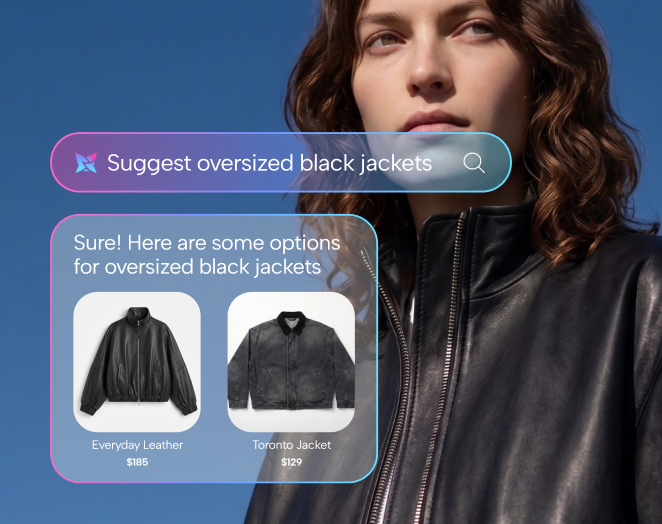
When someone types a vague query like “black boots” into your store, your ecommerce site’s personalized search feature decides which of your thousands of products rise to the top.
The system reads each shopper’s intent and reorders results in real time, based on what they’re most likely to buy. However, most stores haven’t really caught up to these personalization features.
Nosto’s ecommerce site search statistics show that 69% of shoppers go straight to the search bar when they land on a site, and 80% have left a store after a poor search experience. That’s a costly gap for any brand with a large catalog.
Below, we’ll cover what ecommerce personalized search is, how the AI behind it works, what to look for in a tool, and how to measure the payoff.
What is ecommerce personalized search?
Ecommerce personalized search is a type of site search that uses AI to tailor results to each shopper. The system weighs their behavior, purchase history, and your product data to decide what appears first.
Standard site search treats everyone the same. The engine matches the words in a query against your catalog and ranks the results in one fixed order.
Type “chocolate milk,” and a keyword engine might return “milk chocolate” bars. The engine matches a shopper’s words and misses their meaning.
Personalized search closes that gap. 2 shoppers can type the same term and see different results, each ordered around what they’re most likely to buy. You can see how this plays out in these ecommerce search examples from real brands.
How ecommerce personalized search works
Personalized search runs on a few connected layers of intelligent search technology, each doing a different job.
Here’s what happens between the moment a shopper types and the moment results appear.
Behavioral signal capture
Personalized search starts with how your shoppers behave on your site. As each session unfolds, the engine watches a handful of signals provided by the shopper:
The queries a shopper types
The results they click
The filters and refinements they apply
Their past purchases
Every signal sharpens the store’s picture of that shopper, live. The same signals help beyond search, too.
Semantic search figures out what a shopper means, even when their words don’t match your product titles.
Vector search is the engine behind it, turning products and queries into numerical values so the system can match them by meaning and similarity.
The payoff is fewer dead ends. Vague, long-tail, and misspelled queries that would return nothing on a keyword engine still surface useful products.
That cuts down on zero-result pages and the lost sales they cause.
Real-time personalized ranking
Personalized ranking in ecommerce search builds a shopper profile on the fly and reorders results at the moment of the query. No 2 shoppers have to see the same list.
Say 2 people both search “sapphire.” One has been shopping for fine jewelry, and the other collects loose gemstones. Personalized ranking can show each of them a different order, leading with what fits their history.
Search merchandising rules
AI ranking handles relevance well, but you still have business goals the algorithm can’t see.
Merchandising rules let you step in. You can pin, promote, or bury products based on margin, stock levels, campaigns, or the season.
Layer these rules on top of personalization. You steer what gets pushed, and the AI still tailors everything else to each shopper.
The business value of ecommerce personalized search
Better search relevance shows up directly in revenue. The numbers behind AI ecommerce personalization make the case on their own.
McKinsey reports that personalization typically drives a 10 to 15% lift in revenue, with results ranging from 5 to 25% by sector. The same research found that 71% of consumers expect personalization, and 76% get frustrated when they don’t find it.
Search is a prime place to act on that. Shoppers who use your search bar arrive with clear intent, so sharper results convert more of them and raise their order value.
On Nosto’s own platform, brands using personalized search generated 1,024% more revenue through search year over year, alongside a 323% rise in personalized search usage.
Here’s how the 2 approaches compare across the metrics ecommerce teams watch most closely.
Metric
Standard keyword search
Ecommerce personalized search
Conversion rate
Low on generic queries
Higher, since results match individual intent
Zero-result pages
Common on long-tail or misspelled queries
Reduced through semantic and vector AI
Average order value
Little movement
Rises as more relevant products surface
Search abandonment
High when results feel off
Lower through real-time personalization
Merchandising control
Manual, rule-based only
AI ranking plus strategic merchandising rules
Key capabilities to look for in ecommerce personalized search
Not every solution offers the same depth. Beyond the semantic AI, ranking, and merchandising layers already covered, a few capabilities separate strong ecommerce personalization software from the rest.
Keep these in mind as you compare platforms, tools, and services.
Predictive autocomplete
Autocomplete shapes the search as a shopper types. Strong versions suggest relevant products, popular queries, and category shortcuts right in the dropdown, guiding shoppers toward results.
That gets harder at scale. On catalogs with 100,000 or more stock-keeping units (SKUs), autocomplete has to stay fast and accurate, which puts the underlying engine to the test.
A/B testing for search
A good search strategy needs built-in A/B testing that lets your team compare ranking rules, merchandising approaches, and layouts against live traffic, then see which one lifts conversion.
For data-driven marketers, this is non-negotiable. This feature turns opinion into evidence. Some platforms go further and roll out winning variations automatically, so improvements ship without extra manual work.
Multi-language and multi-market support
One search experience isn’t enough for a global catalog. Strong platforms support search in multiple languages out of the box, so shoppers in each region can search in their own language.
Your rules should flex by market, too. What sells in one country may need different personalization and merchandising in another, and your search should adapt to each one.
Common gaps in ecommerce personalized search that hurt conversions
Even brands that invest in search often lose sales to a few recurring gaps. Each one below is something a Head of Ecommerce or Chief Digital Officer (CDO) will recognize from their own store.
Keyword matching alone: Long-tail and misspelled queries dead-end in zero results, and shoppers rarely give a failed search a second try.
Siloed search data: When search behavior doesn’t reach your recommendations, merchandising, or content, you waste the richest intent signal on your site.
No merchandising layer: Pure AI ranking with no way to reflect margin, inventory, or campaigns leaves your team unable to act on business priorities.
Zero-result pages with no fallback: A blank results page is a hard stop. With no suggestions or related products, that shopper is gone.
Weak product data: Search is only as good as the catalog behind it. Thin titles, missing attributes, and inconsistent tags give the engine too little to work with. That’s where ecommerce search enrichment helps, improving product data so relevance has something to draw on.
How Nosto personalized search unifies discovery across the storefront
Brands that want search to inform more than the results page look for a system where discovery data is shared across the storefront.
Nosto’s Personalized Search is built into the Commerce Experience Platform (CXP), so the intelligence it gathers doesn’t stay stuck in the search bar.
That intelligence runs on experience.AI™, Nosto’s neural core. Because search sits on the same platform as the rest of your storefront, the intent it captures flows into the surfaces that shape discovery:
Product Recommendations: Search behavior sharpens the products Nosto suggests across the site.
Category Merchandising: Merchandising rules extend from search to category pages in a few clicks.
Huginn: Nosto’s AI commerce agent works from the same shopper data to guide people in natural language.
One search now shapes far more than the results page.
The search engine was built for retail. Nosto combined 2 dedicated search acquisitions, SearchNode and Findologic, with more than a decade of its own merchandising technology.
The result is an engine designed specifically for ecommerce catalogs.
The impact shows up in shopper behavior. Global surf and lifestyle brand O’Neill A/B tested Nosto’s search and merchandising across its European stores. Conversion rates climbed 21% in the Netherlands and Germany, and 15% in France.
Seen this way, search becomes an intelligence layer that feeds the entire customer journey. You can see the full picture by requesting a demo to see it in your own catalog.
Frequently asked questions (FAQs)
Here are answers to the questions ecommerce and digital leaders ask most often about ecommerce personalized search.
How long does it take to implement ecommerce personalized search?
Most brands go live within a few weeks. Nosto customer A.L.C., for example, had search running in under a month without straining its development team. The ranking models keep improving over the first few weeks as they gather more data.
If your platform supports flexible application programming interfaces (APIs) and a no-code editor, you can keep the load off engineering, so your team can set up and refine search without long development cycles.
Is ecommerce personalized search suitable for B2B catalogs?
Yes. Personalized search in B2B ecommerce works well for brands with high-SKU, complex catalogs, which describes most B2B operations.
Can ecommerce personalized search support multiple languages and markets?
Yes. Modern solutions handle multi-language search natively, so shoppers search in their own language and still get relevant results.
Just as important, you can tune personalization and merchandising rules by market or region. That flexibility matters for global brands running one storefront across many countries.
How does ecommerce personalized search connect to the rest of the storefront?
Done well, search acts as a source of intelligence for the whole store. Search behavior, including queries, clicks, and refinements, feeds Product Recommendations, Category Merchandising, and content personalization.
What should ecommerce teams measure to evaluate personalized search performance?
Ecommerce teams should measure the following metrics to evaluate personalized search performance:
Search conversion rate: The share of search sessions that end in a purchase.
Zero-result rate: How often a search returns nothing.
Search abandonment rate: How often shoppers give up after searching.
Average order value (AOV): The average spend from search-driven sessions.
Revenue per search visit: The revenue each search session brings in.
Conclusion
For mid-market and enterprise brands, generic site search quietly caps conversion. Treating every shopper the same wastes the intent behind each query.
Ecommerce personalized search closes that gap, reading behavior in real time and surfacing the right products for each person.
Search is heading somewhere new. Agentic commerce and conversational discovery are taking hold. Tools like Nosto’s Huginn agent are turning the search bar into an assistant that understands natural language and shops alongside your customers.
If your catalog has outgrown keyword search, that’s your signal to act. Book a demo to see what personalized results could do for your store.
Explore more articles
News & Press
Nosto becomes a Klaviyo Premier Technology Partner
Nosto has been recognized as a Klaviyo Premier Technology Partner, the highest tier in Klaviyo’s technology partner program. This achievement marks an important milestone in our long-standing partnership with Klaviyo and reflects our continued investment in the AI Customer Journey Integration, which brings together Klaviyo’s customer intelligence and Nosto’s commerce intelligence to create more connected […]
Read more Ecommerce
What can AI agents do on Shopify during BFCM 2026?
AI agents on Shopify can now handle merchandising decisions, campaign setup, product recommendations, and real-time customer service responses during BFCM 2026, without needing a developer for any of it. For Shopify BFCM teams, that’s a meaningful shift from AI as a background tool to AI as something that takes action on a brand’s behalf. Here’s […]
Read more Ecommerce
Fashion ecommerce and AI discovery: getting recommended is only half the job
A shopper opens ChatGPT. They type “waterproof outerwear for city commutes, under 200 euros, not black.” They don’t open Google. They don’t visit four brand sites and compare. They ask once, read three recommendations, and click one. By the time they land on your product page, the comparison is finished. The shortlist is made. They […]
Read more Ecommerce
What is an ecommerce search engine? A guide for retailers
Every day, shoppers leave online stores because they can’t find what they came for. And much of that lost revenue traces back to one piece of technology, the ecommerce search engine behind your search bar. When it understands what shoppers want, they buy. But when it doesn’t, they hit a dead end and bounce to […]