Personalized Search
 Category Merchandising
 Product Recommendations
 Post-Purchase Upsell
 Dynamic Bundles
 Personalized Emails
 A/B Testing & Optimization
 Content Personalization
 Behavioral Pop-Ups
 Shoppable UGC
 Shopify Plus
 Shopify
 Salesforce Commerce Cloud
 Shopware
 Adobe Commerce
 BigCommerce
 Klaviyo
 Attentive
 Yotpo
Yotpo Tapcart
 Google Analytics
 TikTok
 Instagram
 Facebook
Fashion ecommerce and AI discovery: getting recommended is only half the job
A shopper opens ChatGPT. They type “waterproof outerwear for city commutes, under 200 euros, not black.”
They don’t open Google. They don’t visit four brand sites and compare. They ask once, read three recommendations, and click one.
By the time they land on your product page, the comparison is finished. The shortlist is made. They aren’t at the top of the funnel. They’re at the end of it, standing on a product page, one decision away.
Most fashion sites aren’t built for that shopper.
The discovery layer moved
Shopify’s new EMEA fashion playbook, From feed to flagship: How fashion brands win in the AI era, puts numbers on the shift. It’s worth reading in full, and we’ve linked it at the bottom.
The headline finding is about where AI search traffic lands. According to Shopify’s Q1 2026 merchant data, more than 55% of AI-referred visits begin on a product page. For organic Google search, it’s around 20%.
That single comparison explains most of the other numbers. The same data shows AI-referred visits converting at close to 50% higher than organic search, and AI-referred orders carrying 14% higher average order value. Traffic from AI sources to Shopify stores grew 8x year over year.
None of that is because AI shoppers are different people. It’s because they arrive later in their own journey.
The playbook frames this as a move from SEO to GEO. Generative engine optimization (GEO) is the practice of getting AI tools to recommend your brand, rather than getting a search engine to rank it. Keywords and backlinks become credibility, structured data, and what customers say about you. It’s a useful frame. But getting recommended is step one.
What happens in the ten seconds after the recommendation
Here’s the part the industry is still underthinking.
An AI assistant sends a shopper to one product. One. Not a category page, not a homepage, not a curated edit. A single product, chosen by a machine reading your product feed.
What if it’s the wrong size? What if it’s out of stock in their market? What if it’s close, but they wanted the cropped version?
In a traditional session, the shopper would browse their way to an answer. They’d use the nav, run a search, click through a category. They had patience because they were still deciding.
The AI-referred shopper has none of that patience, because they already decided. They came for a specific thing. If your product page doesn’t have it, or your site can’t get them to the nearest match in one move, the AI assistant is one tab away and it will happily recommend a competitor instead.
So the question for fashion brands isn’t only “can AI read my catalog.” It’s also: when AI drops a high-intent shopper on a single product page, can my site take it from there?
Three things that break
Depth without a path
Fashion catalogs run deep. Colorways, cuts, seasonal drops, and sizing systems that differ by market. An AI agent picks one item from all of it.
If that item isn’t quite right, the shopper needs the adjacent option immediately, or they bounce back to the assistant and keep searching. Product recommendations that understand a fashion catalog know that a shopper who landed on a linen midi in sage might want the same cut in a different color, or the same color in a different length. Not “customers also bought.”
Alternatives need to sit high on the page, and above cross-sells. A cross-sell to someone who hasn’t accepted the first product yet is a dead end. Camille has written the full how-to on this, including how to track and convert traffic from ChatGPT.
Search that expects keywords
The AI-referred shopper searches differently, because they’ve been trained by the assistant that sent them. They type what they mean. “Something similar but shorter.” “Same jacket, warmer.”
Keyword search returns nothing useful for either. Semantic search understands that “warm jacket for winter hiking” and “insulated waterproof parka” are the same request. If your site search still matches strings, you lose the shopper at exactly the moment the AI handed them over. This is what ecommerce personalized search is built to solve.
One experience for everyone
McKinsey research, cited in the report, shows 84% of shoppers want personalized product recommendations, and 40% have bought a more expensive item because of one. Worth extending that.
An AI-referred shopper arrives with context the AI knows and your site doesn’t. You can’t read the prompt. But you can read the landing product, the referral source, the market, and every signal from the moment they arrive. That’s enough to shape the next click.
The conversation is an experience too
So far this assumes the AI hands the shopper over and your site takes it from there. But the conversation itself is a surface you can shape.
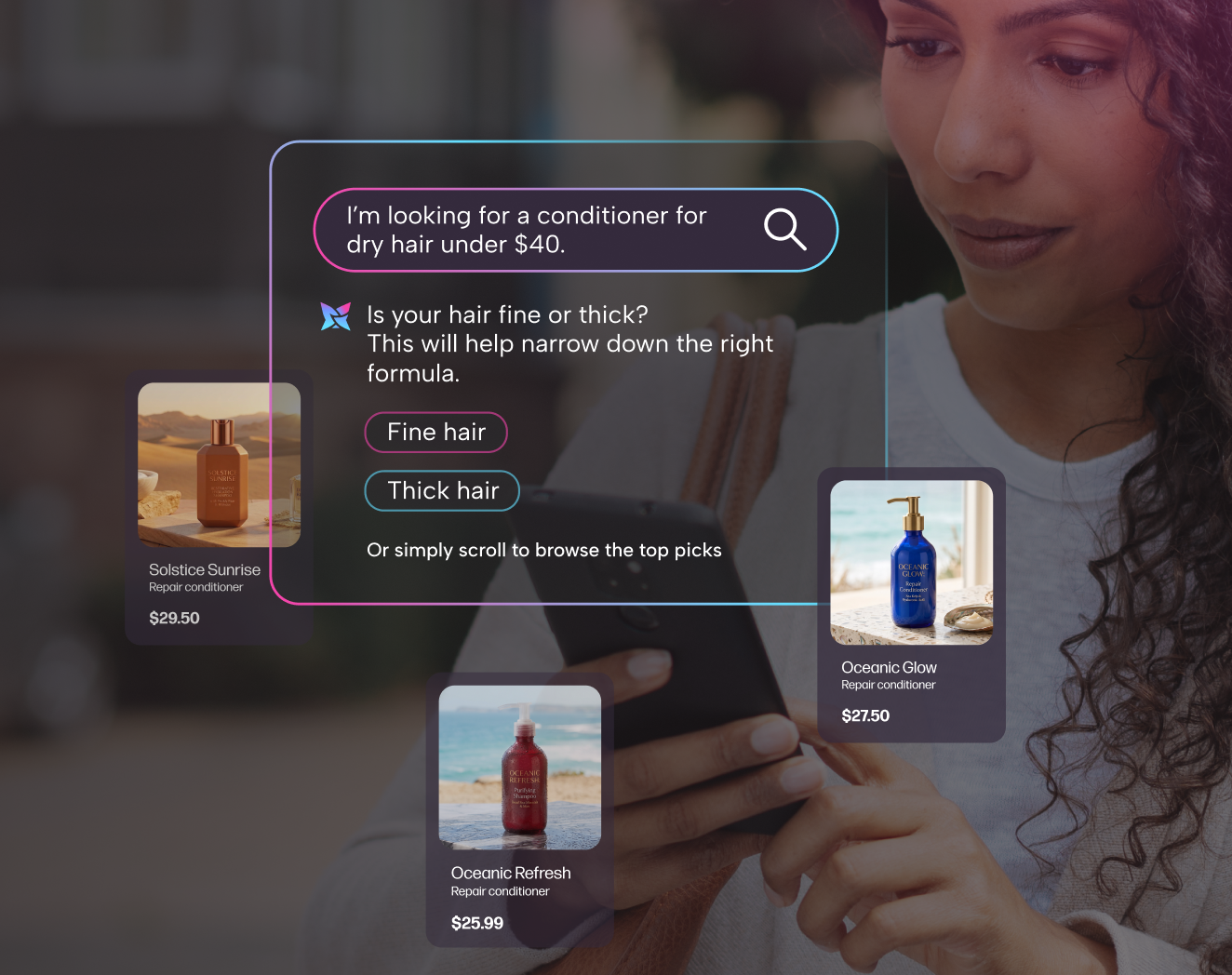
Most AI shopping assistants have the same flaw: everyone gets the same answer. Same question, same response, regardless of what you’ve browsed, bought, or care about. That isn’t personalization. It’s a search bar with a friendlier interface.
That matters more than it sounds. Roughly a third of chatbot interactions are product requests rather than service queries, and those shoppers are often waiting twenty or thirty seconds for a generic recommendation. A conversion problem dressed up as a technology problem.
Our CEO Jim Lofgren has shared one example: Klaviyo came to Nosto with a specific problem. Their new AI customer service agent was slow, and its answers were the same for everyone regardless of browsing history. The fix wasn’t a better language model. It was context. What has this shopper looked at, what intent are they showing, feed that into the response.
That context already exists. Every personalization engine is reading behavioral signals in real time. It just hasn’t historically been available to the assistant doing the talking.
That’s changing. Through APIs and MCP (Model Context Protocol), intent signals can now be passed into a third-party conversational interface, which is what Nosto’s Large Intent Model opened up last October.
So an assistant answering a shopper who’s been browsing cropped linen in sage doesn’t start from zero. It starts from intent.
For fashion, the parallel to Ford’s accessories catalog is closer than it looks. Ford’s runs deep enough to reach individual nuts and bolts, and finding the exact right part is the conversion. Fashion catalogs are deep in a different direction: colorways, cuts, drops, and sizing that shifts by market. Same problem. A generic answer against a deep catalog is a miss.
There’s one question nobody has fully answered yet. Where does merchant control over brand voice end, and personalization to the individual begin? We’re tackling this with Marine Layer in our upcoming BFCM miniseries episode, ‘Marine Layer: The brand first approach’.
The data layer serves every job
The good news? This isn’t three separate projects.
The product data work that makes you visible to AI is the same product data that powers ecommerce product discovery on your own site. Complete attributes, accurate variants, real-time stock, descriptive imagery metadata, and specific material and care detail.
Clean that up and an AI assistant can recommend you. Clean that up and your own search, recommendations, and merchandising get sharper at the same time. It’s also what makes the intent signals worth feeding into a conversation in the first place. Product data is now discovery infrastructure.
The brands that treat it as an AI project will do it once and stop. The brands that treat it as commerce infrastructure will keep compounding.
Where to start: measure it first
Most brands watch traffic from search engines and social platforms closely. Very few can see who arrived from ChatGPT. You can’t fix a channel you can’t count.
The first step is tracking traffic from ChatGPT as its own audience, the same way you’d segment Google or Facebook traffic. Then compare it against the rest of your traffic on conversion rate, average order value, revenue, bounce rate, and abandoned carts, and look at which categories and products it gravitates toward.
Nosto customer tip: this is available as a ready-made ChatGPT segment in Experience.AI™ under Audience Insights & Builder.
That comparison tells you which problem you actually have.
Low AI traffic? Your brand or your key ranges probably aren’t well represented in conversational AI yet. That’s the getting-recommended problem, and Shopify’s playbook is the right place to start.
High AI traffic, weak conversion? You’re getting recommended and losing the shopper after the handoff. That’s alternatives, personalized search, category merchandising, and the assistant experience.
Then three tests, none of which cost anything:
- Search for your own products on the major AI tools. Is your brand there? Is the information right?
- Take a product page an AI would plausibly recommend. Land on it cold, as if you’d never seen the site. Try to reach the nearest alternative in one move.
- If you run an onsite assistant, ask it the same question from two different browsing histories. If the answer doesn’t change, it isn’t personalized.
If any of those fail, that’s the gap.
Get the Shopify fashion playbook
Shopify’s From feed to flagship: How fashion brands win in the AI era covers the full picture: unified commerce, the SEO to GEO shift, agentic commerce and the Universal Commerce Protocol, serving every generation, and retention through loyalty, returns, and resale. It includes merchant results from J.Lindeberg, Castañer, ARMEDANGELS, Rains, Astrid & Miyu, and more, plus a scorecard for assessing your own platform.
Nosto is proud to be an ecosystem partner on this campaign.