Dynamic Yield alternatives: 6 platforms to compare in 2026
Dynamic Yield, part of Mastercard, is one of the most established personalization engines in ecommerce. So when teams look for Dynamic Yield alternatives, it’s rarely because personalization doesn’t work. More often, it comes down to cost, how much of the platform your team can run without developers, and how well personalization connects with search and merchandising as your catalog grows.
This guide compares 6 Dynamic Yield alternatives for mid-market and enterprise ecommerce brands.
TL;DR – Top Dynamic Yield competitors
Here’s a quick look at the top Dynamic Yield alternatives for ecommerce brands:
Platform
Best fit
Core strength
Nosto
Shopify Plus and enterprise ecommerce brands
Unified personalization, semantic search, and merchandising
Bloomreach
Large enterprises with complex commerce stacks
Search and catalog management at scale
InsiderOne
Omnichannel ecommerce and lifecycle teams
Cross-channel personalization and orchestration
Constructor
Search-led ecommerce businesses
AI-powered product discovery and ranking
Athos Commerce
Mid-market brands on Shopify
Accessible semantic search and discovery
Algolia
Developer-led enterprise teams
Flexible and highly customizable search infrastructure
Why do brands look for Dynamic Yield alternatives?
You likely picked Dynamic Yield because it got your personalization strategy off the ground. Dynamic Yield is a recognized leader in personalization, but as your business grows, your needs expand to include search performance, merchandising agility, operational efficiency, and large-scale product discovery.
Here are the most common reasons brands start evaluating alternatives:
Modular scalability and cost efficiency: As teams scale, they often evaluate alternatives that tie software costs directly to feature adoption. Unified personalization platforms address this by combining search, merchandising, and product recommendations within a scalable pricing model.
Pricing is quote-based and built for enterprise budgets: Dynamic Yield pricing isn’t published, and contracts are negotiated with sales. For mid-market brands, the key question is whether the investment matches the features you’ll actually use, and how much implementation and engineering time comes on top of the license.
Day-to-day execution can slow down for lean teams: Launching tests, adjusting recommendation logic or building new page experiences can require developer support. When everyday merchandising tasks wait in an engineering queue, it limits how quickly your team can react to shopper behavior.
Personalization, search and merchandising need to share one data layer: Dynamic Yield added AI-powered Experience Search in 2025, so the question is no longer whether a platform offers search. It’s how deeply search, category merchandising and recommendations share the same shopper data, and how much of that your ecommerce team can run on its own.
What to look for in a Dynamic Yield alternative
Choosing a Dynamic Yield alternative is a major operational decision. As your catalog grows, you need a platform that handles personalization, discovery, and category merchandising without adding to your technical to-do list.
Here are the key features you should look for before making a platform decision:
Artificial intelligence and personalization depth: As your audience grows, AI-driven personalization scales much faster than manual, rule-based workflows. Look for an adaptive intelligence engine that improves your product recommendations, ecommerce strategy, and search relevance automatically.
Search and discovery capabilities: The best ecommerce search personalization uses hybrid and vector search to help shoppers find products even with vague or conversational queries. You should be able to control rankings and campaign visibility directly without waiting on developers for every small change.
Unified data and control: An agentic Commerce Experience Platform (CXP) works best when AI search, merchandising, and recommendations share the same data engine. Using shared signals creates a consistent ecommerce customer experience for your shoppers across every page.
Merchandising controls across search and category pages: Your team should be able to boost, bury and pin products based on margin, inventory and seasonality, in both search results and collection pages, without opening a developer ticket.
Platform fit for your commerce stack: If you run on Shopify Plus, check for a native integration, support for Shopify Markets and multi-currency storefronts, and how the platform handles variant-heavy catalogs. The best options layer onto your existing stack instead of requiring a rebuild.
The top Dynamic Yield alternatives for enterprise ecommerce
The best Dynamic Yield alternative for your brand depends on your catalog and how much hands-on control you want. Here are the top 6 Dynamic Yield alternatives for enterprise ecommerce brands to help you scale:
Connect naturally with Shopify Markets and your existing ecommerce workflows.
Marc Jacobs, for example, used Nosto to automate recommendations, personalize discovery journeys, and improve merchandising efficiency across the storefront, with Nosto contributing 7–10% of annual online sales and 22% of site sales during Black Friday and Cyber Monday (BFCM) 2024.
Book a demo to see how Nosto helps you automate and optimize your product discovery and personalization goals.
2. Bloomreach
Bloomreach is an enterprise platform that combines personalization, marketing automation and AI search for retailers with complex commerce ecosystems.
Where it fits vs. Dynamic Yield: Brands that want onsite personalization and omnichannel marketing (email, SMS, push) from one enterprise suite.
Strengths: Customer data and campaign orchestration (Engagement), AI search and merchandising (Discovery), and Loomi AI across both.
Keep in mind: Value scales with data volume and catalog size, and full deployments typically need dedicated technical resources.
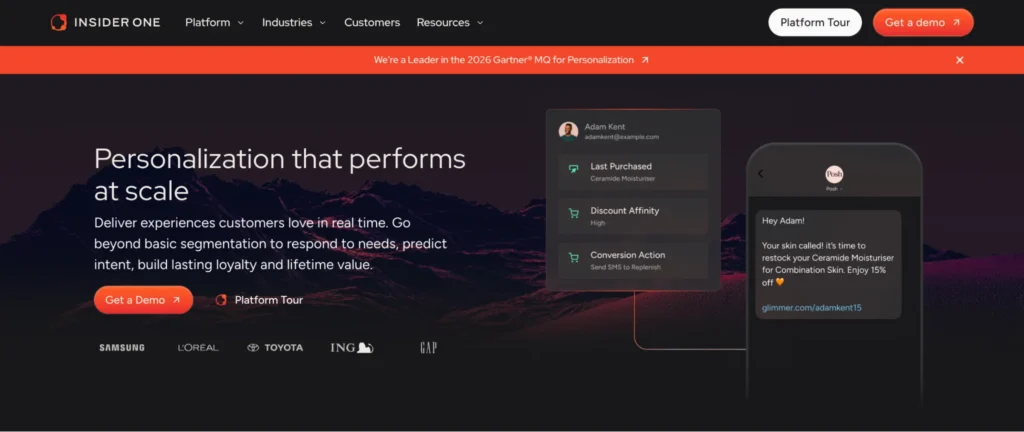
Insider One (formerly Insider) is a cross-channel personalization platform for coordinating experiences across web, app, email, SMS and messaging channels.
Where it fits vs. Dynamic Yield: Teams whose priority is lifecycle marketing and cross-channel journeys, rather than onsite product discovery.
Strengths: Audience segmentation, predictive targeting and journey orchestration across channels.
Keep in mind: If onsite search and category merchandising are your main gaps, check how deep its native capabilities go for a large catalog.
4. Constructor
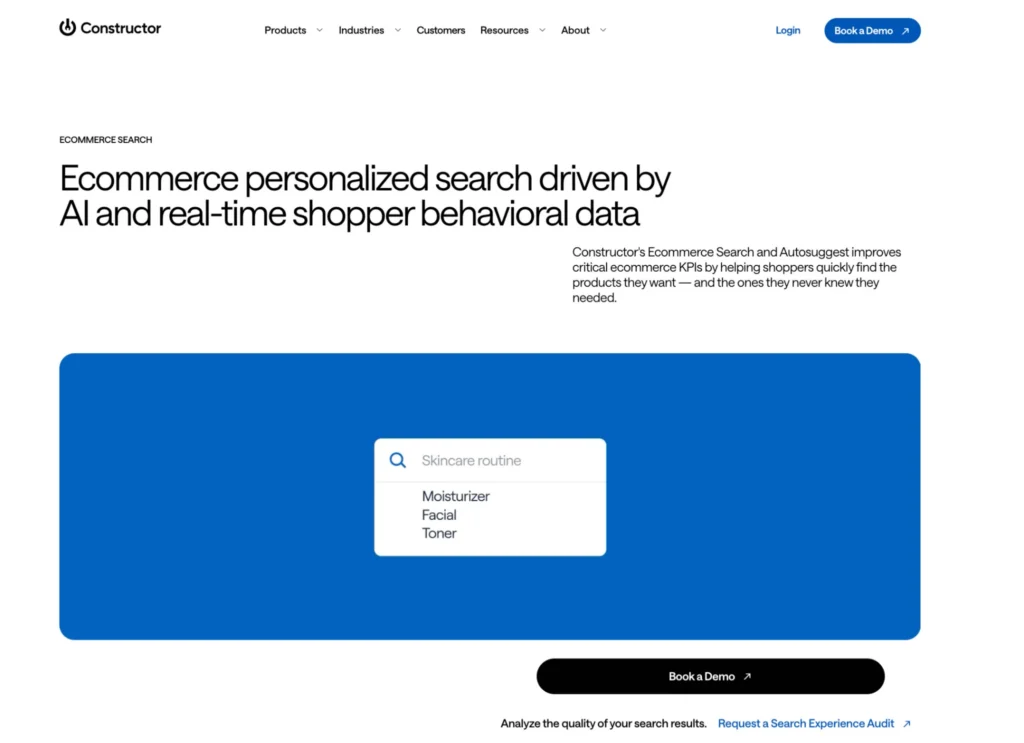
Constructor is a product discovery platform built for ecommerce search, browse, recommendations and merchandising.
Where it fits vs. Dynamic Yield: Search-led brands where onsite search is the main revenue driver.
Strengths: Search and autosuggest, behavior-based ranking, recommendations and AI attribute enrichment. Keep in mind: It focuses on product discovery, so teams often pair it with separate tools for content personalization and cross-channel messaging.
Athos Commerce was formed in 2025 when Searchspring and Klevu merged. It combines site search, merchandising, recommendations and reporting for mid-market ecommerce brands.
Where it fits vs. Dynamic Yield: Mid-market teams that mainly need better search and merchandising, without a long enterprise implementation.
Strengths: Site search, merchandising controls, product recommendations and reporting.
Keep in mind: Personalization beyond search and recommendations is narrower than a full personalization engine. As a recently merged company, also check which platform your contract is based on.
6. Algolia
Algolia is an API-first search and discovery platform built for speed and flexibility.
Where it fits vs. Dynamic Yield: Developer-led teams that want to build custom search and discovery experiences across several properties.
Strengths: Hybrid keyword and AI search, recommendations and broad developer tooling.
Keep in mind: Usage-based pricing grows with traffic and catalog size, and ecommerce-specific merchandising and personalization depend on your plan and engineering capacity.
How to switch from Dynamic Yield without losing momentum
Choosing an alternative to Dynamic Yield usually seems very simple at first. The challenge shows up later, when the platform has to support real merchandising workflows, evolving catalogs, lean internal teams, and constant optimization across the storefront.
Here are some useful steps to guide you during platform evaluation:
Audit what’s live. List your active campaigns, tests, recommendation strategies and audience segments, and decide which to rebuild, which to retire and which to improve.
Capture a baseline. Export your key metrics (conversion rate, revenue per session, recommendation revenue) so you can measure the new platform against real numbers.
Judge platforms on daily use, not feature lists. A platform can look impressive in a demo and still slow your team down. Check who can change search, merchandising and tests without a developer.
Plan the setup work, not just the integration. Catalog cleanup, event mapping and team training take time. Plan the evaluation around your contract renewal date so you have room for a proper pilot.
Roll out in phases and test fairly. Start with the highest-impact area, often recommendations or search, and compare against your baseline on the same pages and traffic before switching fully.
Nosto is built to go live in weeks without stretching your development team, so you can run a pilot alongside your current setup before committing. Book a demo to map out your switch.
Frequently asked questions (FAQs)
Here are answers to the questions Heads of Ecommerce most commonly ask when evaluating Dynamic Yield competitors.
What separates a Commerce Experience Platform from a point solution?
A Commerce Experience Platform brings personalization, search, merchandising, and product recommendations together through one shared personalization engine. That means your search results, category pages, and recommendations all learn from the same customer behavior and catalog data.
For ecommerce teams managing large catalogs, this creates a more consistent storefront experience and removes the operational friction of stitching together separate tools for every function.
How much does Dynamic Yield cost?
Dynamic Yield doesn’t publish pricing. Contracts are quote-based and negotiated with sales, depending on traffic, features and support level. When comparing alternatives, include implementation and ongoing team time, not just the license fee.
Which Dynamic Yield alternatives work well with Shopify Plus?
Look for a native Shopify Plus integration, fast implementation and no-code merchandising controls. Nosto, a Shopify Plus Certified Partner, connects personalization, search and merchandising without a long engineering roadmap, which helps lean teams with large or multi-market catalogs launch faster.
Does switching personalization platforms require a full re-implementation?
Most modern commerce experience platforms plug into your existing stack through Application Programming Interfaces (APIs) and connectors, so you usually avoid a full storefront rebuild.
You can often roll out features like search, recommendations, or merchandising in phases to keep things manageable for your team. While timelines depend on your catalog, many platforms go live within weeks rather than months.
How does semantic search handle large catalogs better than keyword-based search?
Keyword search relies on exact matches, which fail when shoppers use conversational or intent-heavy queries. Semantic search improves ecommerce search personalization by using natural language processing and vector embeddings to understand what your shoppers actually mean.
This leads to better product discovery and higher conversion rates across those tricky long-tail queries.
What data does a personalization platform need to start delivering results?
Most personalization platforms begin learning from onsite behavioral signals such as product views, clicks, searches, and add-to-cart activity, alongside your product catalog data. That behavioral context helps the platform identify shopper intent quickly, even without years of historical data.
For brands migrating from a legacy solution, this reduces friction and ensures your ecommerce product recommendations strategy improves shortly after launch.
Conclusion
The best Dynamic Yield alternative depends on your main gap. Bloomreach and Insider One suit teams that want personalization tied to cross-channel marketing. Constructor, Athos Commerce and Algolia focus on search and discovery. Nosto brings personalization, search and merchandising together on one data layer for brands that want all three without stitching tools together.
Nosto takes that further with Huginn, its built-in AI commerce agent. Powered by experience.AI™, Huginn continuously interprets shopper behavior, merchandising signals, and transactional data to optimize search, recommendations, content, and product discovery in real time. That means your team spends less time managing workflows manually and more time focusing on strategy and growth.
Schedule a demo and see how Huginn helps ecommerce teams scale personalization and product discovery with agentic AI.
Explore more articles
Ecommerce
5 Best Klaviyo Agencies in the UK (2026)
Most ecommerce brands personalize in two places that never talk to each other. The site shows every visitor the same homepage while the email program carefully segments VIPs from first-timers, or the site is beautifully personalized and the welcome flow is a generic template. Either way, the shopper feels the join. The brands that convert […]
Read more Ecommerce
Algolia reviews: what ecommerce teams actually think
Algolia is a search Application Programming Interface (API) built for speed. A lot of ecommerce teams end up evaluating it because it’s fast, well-documented, and widely used across industries. If you’re deciding whether Algolia fits your store, this breakdown on Algolia reviews covers what ecommerce teams actually report: what works, what it costs at scale, […]
Read more News & Press
Nosto Appoints Tatu Koistinen as Chief Executive Officer
Commerce platform veteran to lead Nosto’s next chapter in AI-powered product discovery, as global brands including Avon Cosmetics, SAME LA and Showroomprivé join the platform NEW YORK, NY — November 17, 2026 — Nosto, the agentic Commerce Experience Platform (CXP) trusted by more than 1,500 brands in over 100 countries, today announced the appointment of […]
Read more Ecommerce
Introducing Nosto AI Search: A shorter path from search to purchase
A shopper searching for “repair conditioner” and one asking for “something for hair that feels dry after washing” may be looking for the same product. Both are expressing intent. Helping them act on it is where search creates value. For retailers, that can mean the difference between a purchase and a missed opportunity. In Nosto’s […]
 Commerce Search
 Category Merchandising
 Product Recommendations
 Post-Purchase Upsell
 Dynamic Bundles
 Personalized Emails
 A/B Testing & Optimization
 Content Personalization
 Behavioral Pop-Ups
 Shoppable UGC
 Shopify Plus
 Shopify
 Salesforce Commerce Cloud
 Shopware
 Adobe Commerce
 BigCommerce
 Klaviyo
 Attentive
 Yotpo
 Tapcart
 Google Analytics
 TikTok
 Instagram
 Facebook